Travelling with a mobility aid (or any other assistive device) can make your journey seem daunting, but it doesn’t have to be. We have listed all information to help you on your way and prepare accordingly for your trip.
How many mobility aids can I carry with me?
You may bring a maximum of 2 mobility aids with you. This is free of charge and on top of your free baggage allowance:
2 wheelchairs or rollators
2 pairs of crutches, braces or other prosthetic devices*
2 walking canes
A combination of the above (e.g. 1 wheelchair and 1 walking cane)
* When travelling with prosthetic devices, you should always let us know in advance.
Can I take my mobility aid on board?
Crutches, walking canes and prosthetics are allowed on board and do not need to be transported in the hold.
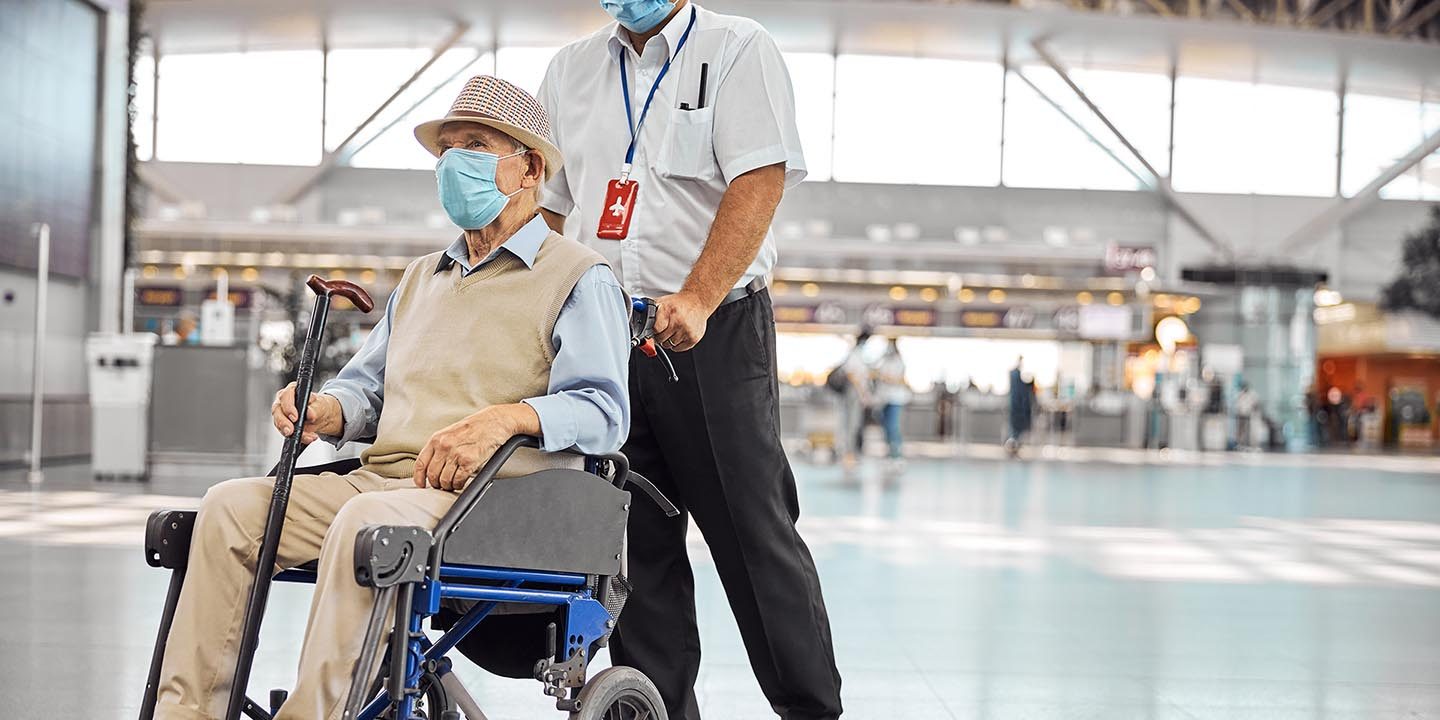
Is it hard for you to walk long distances? Consider requesting special assistance at the airport. Our staff will arrange a wheelchair or cart to bring you to your departure gate. The same service will be offered in between connecting flights and upon arrival at your destination airport.
Passengers who need to be transported on a stretcher will require a medical escort provided by the passenger or the passenger's insurance company.
Due to their size, wheelchairs, rollators and other similar mobility aids can only be transported in the hold. This service is free of charge, but we need the dimensions to plan the space in the hold. Contact our medical assistance team well in advance with the exact dimensions.
You can hand over your mobility aid at the check-in desk and have a wheelchair or cart arranged to bring you to your departure gate, or you can use your mobility aid up until the gate, where the airport staff will store it in the aircraft hold.
Upon arrival, your mobility aid will be returned to you at the arrival gate or at the baggage belt. In the latter case, the airport’s special assistance team will transport you by wheelchair or cart to the baggage belt.
Good to know
In general, passengers can fly with a plaster cast. We recommend travelling with a certificate from your doctor to prove that you’re fit to fly. If your plaster cast was put on under 48 hours before your departure, it might be split open to avoid impending blood circulation. More info
Our cabin crew will assist you as much as they can with the following:
support during boarding and disembarking
opening packages of meals
There are certain things the crew are not allowed to do, such as:
provide assistance in the toilet
lift or carry you
assist you with meals
administer medication or supervise the taking of medication
For safety reasons, crew members are not authorised to carry or lift passengers between the passenger seat and a wheelchair or to assist passengers during a visit to the lavatory.
Passengers with reduced mobility should also bear in mind that the toilets in an aircraft are generally quite small.
Depending on the battery type of your battery-powered device, different guidelines apply.
Foldable/collapsible wheelchair: The battery must be removed, protected from short circuits and transported in the hold in a strong, rigid packaging.
Non-foldable/non-collapsible wheelchair: The battery may remain in your wheelchair, as long as the electrical circuits have been isolated and the battery is securely attached to your wheelchair.
Lithium batteries
Foldable/collapsible wheelchair: The battery must be removed, protected from short circuits, and placed in a protective pouch. The removed battery may not exceed 300Wh (or for a wheelchair that needs 2 batteries to operate, each battery may not exceed 160Wh).
Non-foldable/non-collapsible wheelchair: The battery may remain in your wheelchair, as long as the electrical circuits have been isolated and the battery is securely attached to your wheelchair.
Wheelchairs with permanently installed, non-removable lithium batteries: From October 1, 2025, wheelchairs or other mobility aids with a permanently installed, non-removable lithium battery will be subject to a limit of a maximum of two batteries, each with a capacity of up to 160 Wh. If your booking request was confirmed before October 1, 2025, or if you started your trip before October 1, your wheelchair or mobility aid will still be transported.
Wet or spillable batteries
If the wheelchair can be loaded, stowed and unloaded in an upright position, the battery may stay in the wheelchair as long as:
The battery terminals are protected from short circuiting
The battery is fitted, where feasible, with spill-resistant vent caps
The battery is securely attached to the wheelchair
Electrical circuits have been isolated per the manufacturer's instructions
The wheelchair with batteries is secured with straps, tie-downs or other restraints against movement.
If the wheelchair cannot be loaded, stowed and unloaded in an upright position:
The battery must be removed and shipped as cargo
The wheelchair itself can be transported as checked baggage
Yes, even if the battery is exceeding the new limit of 160 Wh, if your wheelchair/mobility aid was confirmed before October 1st, 2025, it will be transported as booked.
US regulation 14CFR, DOT382 on direct flights to and from the USA
To Aviation Consumer Protection Division The link will be opened in a new browser tab
Please note that with this link you are visiting an external website that may not follow the same privacy, security or accessibility policies.
This regulation applies to all flights that begin or end at a US airport.
Brussels Airlines is committed to handle your wheelchair or scooter (herein referred to as “mobility device”) with care. Despite our best efforts, mobility devices may sometimes be damaged or delayed.
If your mobility device is damaged, request a refund of the repair costs you have incurred via this link Baggage | Brussels Airlines
Additionally, in the event of any mishandling of your mobility device, please ask for one of our specially trained contact persons, the Complaint Resolution Official (CRO). This employee understands the relevant regulations of the US authorities and will deal with your concerns.
Our CROs are available at all our US destinations and in Brussels.
Delay
In case of a delayed return of your mobility device, you may choose between picking up the delayed mobility device at your destination airport or having it delivered to a reasonable location such as your home or hotel.
We will reimburse transportation expenses to and from the airport that you incurred as a direct result of your mobility device being delayed. You may be required to submit documentation that substantiates the cost.
Loaner
If your device has been mishandled on your flight, you have the right to receive a loaner wheelchair from us with customizations that meets their function and safety requirements as much as possible while you are waiting on returns, repairs or replacements for your mishandled device. If this is not possible, you can secure your own alternative loaner mobility device. The associated cost will be reimbursed within 30 days of your submission of the documentation substantiating the expense.
Repair or replacement
In case of a damaged or lost mobility device, you will be offered the following options:
Brussels Airlines will handle the repair or replacement of the device, with a device of comparable function and safety at our expense.
Arranging the repair or replacement of the device through your preferred vendor with Brussels Airlines having the responsibility to transport the device to the preferred vendor and to pay the vendor directly for the associated cost.
Restrictions for loading of mobility devices: Aircraft door dimensions
We’ll do our best to accommodate your mobility device. To ensure that your mobility device fits through the cargo door, please check the door sizes of our aircraft: