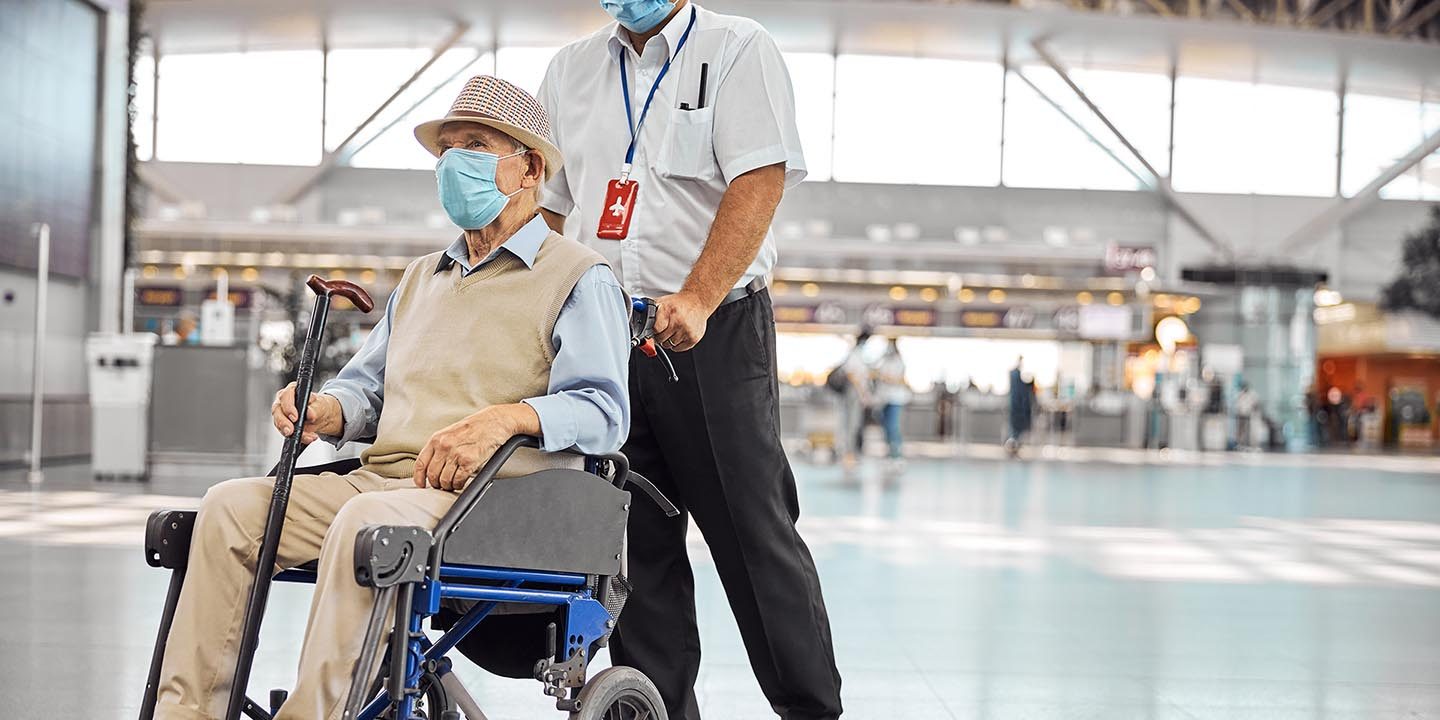

If needed, the airport’s special assistance team will guide you through the airport. When you have a connecting flight, we’ll also arrange guidance at your transit airport.
Sensory impairment and cognitive disabilities
There are no restrictions on board for passengers with sensory impairment or cognitive disabilities. However, to ensure the most comfortable flight experience possible, we highly recommend flying with a travel companion or requesting special assistance.
Who should ask for special assistance?
Special assistance is mandatory for:
- Passengers with mental impairments.
Special assistance is recommended for:
- Blind or visually impaired
- Deaf or hearing impaired
- Mute or speech impaired
As flying is not a routine event for most people, it will help to have a familiar person around in case of unexpected changes at the airport or during the flight. If you are both blind and deaf, you must travel with a companion.
Your guide dog is also welcome to travel with us. More info.
Hidden Disabilities Sunflower
Brussels Airlines is a member of the Hidden Disabilities Sunflower programme, which assists people who have invisible disabilities.
If you are wearing the Sunflower symbol, this is a discreet sign that you have an invisible impairment. This makes it clear that you might need help or extra time.
Please note: the Sunflower is not a guarantee of special services. Nevertheless, our colleagues will assist you as much as possible so that you can travel feeling relaxed and safe.
We can only guarantee certain services, such as pre-boarding, if your requirements have been registered and confirmed with the code DPNA in your booking. DPNA is the international IATA code for people with cognitive impairments who need assistance.
Please note that with this link you are visiting an external website that may not follow the same privacy, security or accessibility policies.

How will we assist you?
If you need help during the flight, our cabin crew will gladly assist you with:
- boarding and disembarking
- stowing away your hand baggage
- opening packages of meals
- explanations about the arrangement of meal trays, if needed
- a personal safety briefing
- one-to-one information about travel announcements such as delays
Our crew will do their utmost and help when needed. However, there are certain things they are not allowed to do for safety reasons:
- provide assistance in the toilet
- lift or carry you
- assist you with meals
- administer medication or supervise the administration of medication
Why travel with a travel companion?
Taking a plane is not an everyday event. It means navigating through unfamiliar locations, sometimes in crowded places, and being able to cope with procedures that can be stressful.
If your family member or friend has a mental impairment, it’s important to evaluate their ability to cope with situations they are unaccustomed to such as:
- Navigating through large international airports, sometimes with multiple terminals
- Understanding and being capable of following the procedures of security checkpoints, passport control and customs
- Understanding and communicating with the crew about safety instructions
- Coping with unexpected situations such as boarding gate changes, schedule changes, turbulence, etc.
Remember that a travel companion is always mandatory for passengers who are unable to help themselves in the event of an emergency evacuation, are unable to communicate with the crew or are incapable of understanding safety instructions.
Good to know
Minors with any kind of disability (physical and/or mental) must be accompanied by an adult. In very exceptional cases, they may be accepted as unaccompanied minors but this will be assessed on a case-by-case basis by the Medical Assistance Co-ordination Service.